Our certifications
Every inspection, recharge, or requalification we perform is done by trained, certified personnel working to the right standard. We are transparent about all the certifications our team holds, and we provide the proof on request.
Updated: June 2026
Our transparency commitment
Fire compliance is not a place to guess. A recharge done wrong or a requalification that is not valid can be rejected by the authority having jurisdiction, and you are the one who pays for it at the worst possible time. So we keep our team's certifications current and we show them on request, no runaround.
If you want to see who did the work and under what credential, just ask. Every report produced in Canuck360 keeps a record of the technician and the date, which gives you a verifiable file at any time.
Portable extinguishers (NFPA-10)
Maintenance and recharge of portable extinguishers fall under NFPA-10. The person doing this work must be certified: they have to pass an exam administered by an organization considered acceptable by the authority having jurisdiction, an exam that covers knowledge of the chapters and annexes of the standard.
Whoever passes receives a document or attestation confirming their qualification. That attestation must be made available on request of the authority having jurisdiction. This is exactly the kind of proof we keep accessible for our team.
- Reference standard: NFPA-10
- Exam accepted by the authority having jurisdiction (AHJ)
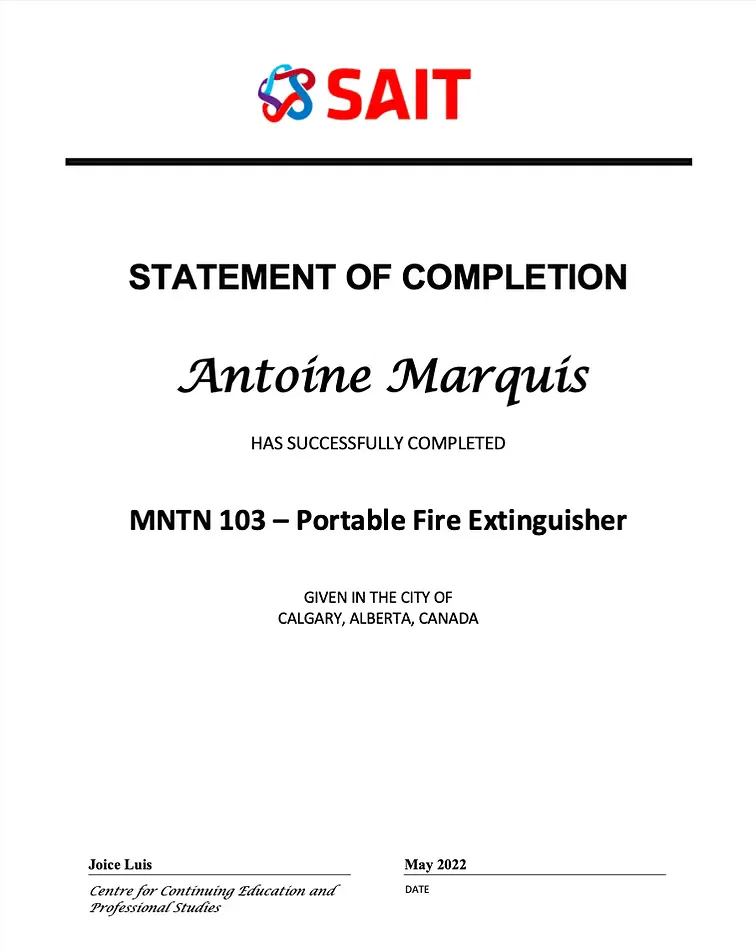
- Our team's attestation: SAIT, MNTN 103 Portable Fire Extinguisher (2022)
Automatic suppression systems (NFPA-17)
Automatic suppression systems, such as those protecting commercial kitchen hoods, fall under NFPA-17. The service technician must be trained and must pass a written or online examination considered acceptable by the authority having jurisdiction.
They must also hold a certification document confirming they meet the requirements, issued by the manufacturer or by a testing body recognized by the authority having jurisdiction. We work with personnel who hold this credential for this type of system.
- Reference standard: NFPA-17
- Trained and examined technician per the AHJ
- Certification from the manufacturer or a recognized body
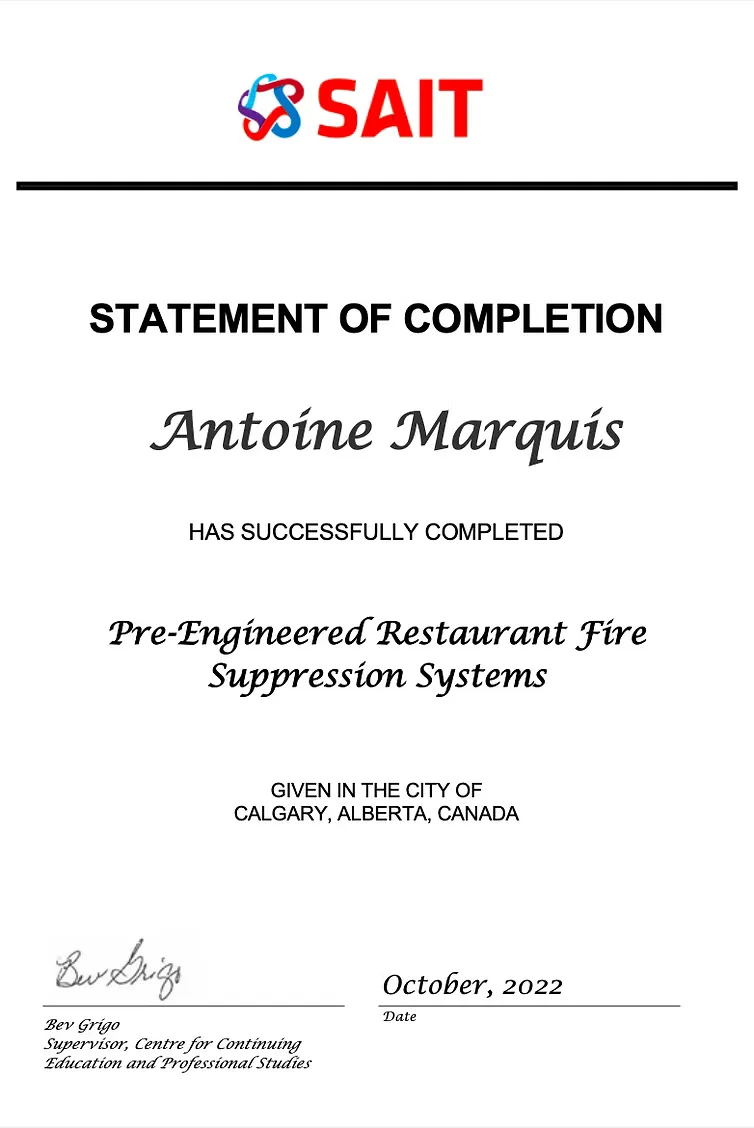
- Our team's attestation: SAIT, Pre-Engineered Restaurant Fire Suppression Systems (2022)
High-pressure cylinder requalification (Transport Canada / TDG)
Requalification of high-pressure cylinders, such as Class 2 compressed-gas bottles, falls under Transport Canada through the Transportation of Dangerous Goods Regulations (TDG) and CSA standards B339, B340, B341 and B342. This work cannot be done just anywhere.
The facility performing the requalification must be registered with Transport Canada, and personnel must demonstrate qualification through training, skills, and experience. We send these cylinders to a registered facility so the requalification is valid and recognized.
- Authority: Transport Canada (TDG)
- Standards: CSA B339, B340, B341 and B342
- Class 2 dangerous goods (compressed gas)
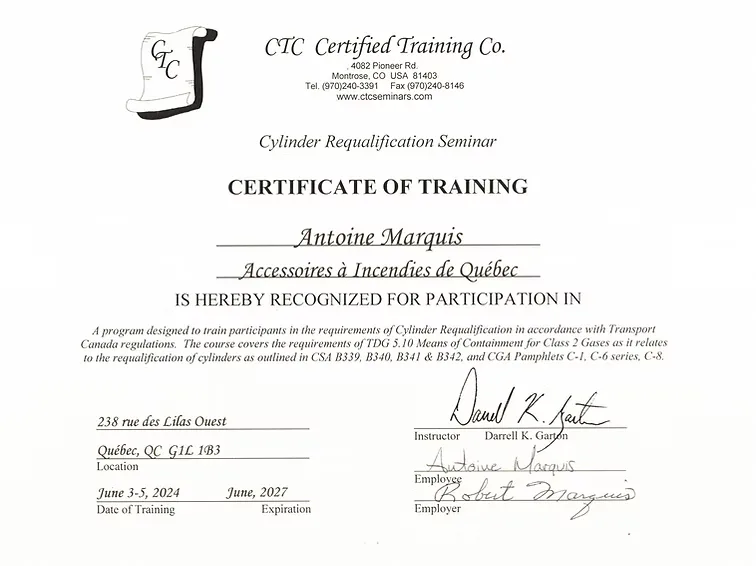
- Our team's attestation: CTC Certified Training Co., cylinder requalification (valid to June 2027)
Why this protects you
A valid credential is not a formality: it is what makes your compliance file defensible to an insurer, a municipal inspector, or the authority having jurisdiction. When the work is done by the right person to the right standard, your record holds up.
You keep the history in one place. To book an inspection or check a specific credential, call us at 418-905-3396.
Our team's attestations
Click a document to view it in full.